
OpenStack gives organizations significant flexibility and control over cloud infrastructure. But that flexibility can also come with a learning curve.
Even a straightforward server deployment may require a user to understand networking, bootable images, storage, external IP addressing, security groups, and the correct sequence in which each resource needs to be configured.
Key Takeaways
- Natural language simplifies OpenStack cloud management. Users can describe an intended outcome instead of manually executing every infrastructure step.
- Complex workflows are easier to execute. Liberty AI can coordinate supported multi-step tasks where infrastructure must be created in the correct sequence.
- Existing permissions stay in place. Liberty AI operates with the roles and permissions of the logged-in user.
- Built-in guardrails maintain control. Confirmation requirements, quotas, batch limits, audit logging, and a defined OpenStack toolset constrain what the assistant can execute.
- Liberty AI is included at no additional charge as part of the Liberty Cloud Platform.
What if you could simply tell your cloud what you need?
That is the idea behind Liberty AI.
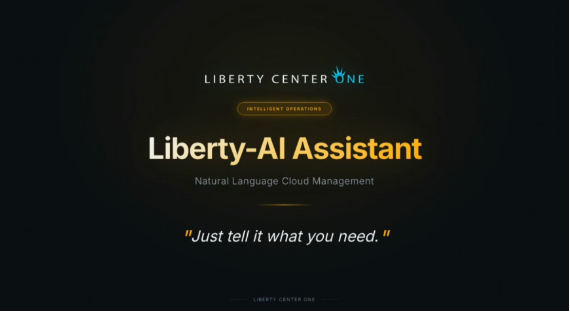
Liberty Center One has introduced Liberty AI, a natural language assistant built directly into the Liberty Cloud dashboard and OpenStack interface. Instead of navigating multiple screens or memorizing CLI syntax, users can describe an infrastructure objective in plain English and allow Liberty AI to execute supported actions within their existing permissions.
Liberty AI isn’t designed to replace technical expertise. It’s designed to make that expertise easier to apply by simplifying how users interact with OpenStack cloud infrastructure.
What Is Liberty AI?
Liberty AI is a natural language assistant that enables users to manage OpenStack cloud infrastructure by describing what they need in plain English.
Built directly into the Liberty Cloud dashboard and OpenStack interface, Liberty AI can perform supported infrastructure actions using the authentication, permissions, and roles of the logged-in user.
Users can ask Liberty AI to provision infrastructure, check quotas, explain what is running within a project, or provide recommendations for a particular configuration without needing to translate every objective into individual commands or dashboard steps.
Liberty AI: Plain English, Real Infrastructure
The value of natural language cloud management becomes clearer when you look at what it takes to complete an actual OpenStack deployment.
Imagine an administrator needs a new web server.
Traditionally, creating that instance may involve configuring or selecting a network, choosing a bootable image, determining disk sizing, assigning external IP addressing, configuring security groups, and making sure those resources are created in the appropriate sequence.
With Liberty AI, the starting point can instead be a simple request:
“I need an Ubuntu server running nginx with a public IP address for web services.”
Liberty AI interprets the request and handles the underlying infrastructure requirements including networking, the bootable image, disk sizing, external IP addressing, and security group configuration before deploying the server and requested services.
Liberty AI isn’t simply a chatbot that explains cloud infrastructure. It translates natural-language requests into supported actions against real infrastructure within the user’s authorized
OpenStack environment.
Users can also ask Liberty AI to check available quotas, explain resources running within a project, or provide recommendations for specific configurations.
For experienced engineers, this creates another way to move through ad hoc infrastructure tasks. For administrators or developers who don’t work inside OpenStack every day, it reduces the amount of platform-specific knowledge required before they can accomplish useful work.
How Does Liberty AI Simplify OpenStack Cloud Management?
Liberty AI is particularly useful when an infrastructure request involves multiple services that need to be configured in the proper sequence.
A CLI or SDK gives experienced administrators significant control, but the user must know the appropriate syntax and understand the order in which operations need to occur.
A graphical dashboard removes the syntax requirement, but it doesn’t eliminate the need to understand the platform. Users may still need to move between several screens and know where different configuration options reside.
Liberty AI introduces another way to interact with the OpenStack cloud environment: start with the intended outcome.
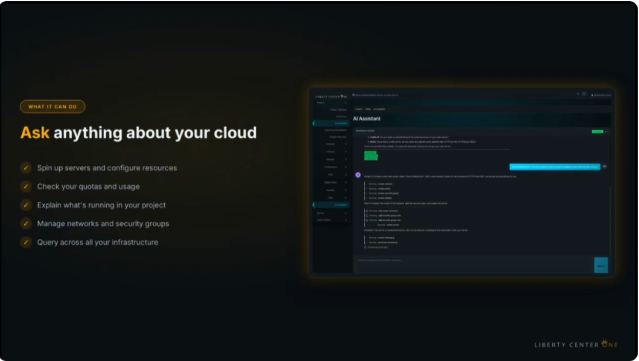
The user describes what needs to be accomplished. Liberty AI interprets that intent and uses its available OpenStack capabilities to execute the supported infrastructure actions required to complete the request.
This can make a meaningful difference across teams with different levels of OpenStack experience.
A junior administrator or developer who doesn’t frequently work within the OpenStack interface can perform supported tasks that might previously have required escalation to a senior administrator. Meanwhile, experienced engineers gain a faster interface for appropriate ad hoc tasks without having to manually work through each individual step.
Because Liberty AI is integrated directly into the LCO Cloud portal and OpenStack interface customers already use, there is no separate AI account or additional login to manage.
Liberty AI Guardrails Keep Users in Control
Allowing an AI assistant to interact with real infrastructure naturally raises questions about permissions, unintended actions, and operational control.
Liberty AI was designed to address those concerns at several levels.
First, the AI does not receive elevated access.
Liberty AI uses the same authentication token, permissions, and roles as the person currently logged into the platform. If a user isn’t authorized to perform an infrastructure action, Liberty AI cannot bypass that restriction on the user’s behalf.
Second, potentially destructive actions require additional confirmation.
Destructive operations are risk-classified and require an explicit confirmation step before execution. Liberty AI cannot silently delete infrastructure because of an incorrectly phrased request.
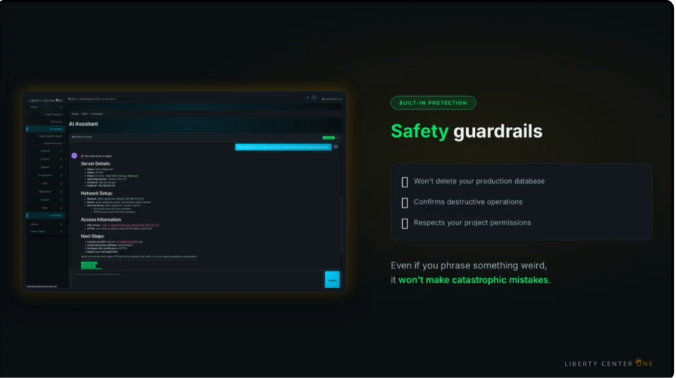
Third, resource consumption remains constrained.
Batch limits and existing user quotas help protect against uncontrolled resource creation or unexpected usage, while full audit logging provides visibility into actions performed through the assistant.
Finally, Liberty AI operates within a fixed, defined toolset mapped to OpenStack SDK calls. It cannot simply invent a new infrastructure action and execute it.
That technical distinction is important.
The natural language interface makes it easier to communicate intent, but the actions available to Liberty AI remain bounded by defined capabilities, existing permissions, and platform controls.
Liberty AI vs. CLI, Dashboards, and Infrastructure-as-Code
Liberty AI isn’t intended to replace the tools engineers already rely on to manage cloud infrastructure.
It gives them another option.
CLI and SDK workflows remain powerful for administrators who want precise command-level control. However, they require syntax expertise and knowledge of the appropriate sequence of operations.
The OpenStack dashboard provides a graphical alternative, but more complex tasks may still require moving between multiple screens and understanding where individual controls are located.
Infrastructure-as-code tools such as Terraform, Heat, and Ansible excel at another type of work: predefined, repeatable, and version-controlled infrastructure. But those workflows require someone to create and maintain appropriate templates.
Liberty AI is particularly suited to the space between those approaches: ad hoc infrastructure work where the desired outcome is known, but a predefined automation template may not exist.
For example, if an organization repeatedly deploys an established production environment, Terraform may remain the appropriate tool. If an administrator needs to build a new environment that hasn’t been templated, Liberty AI provides another way to communicate that intent and execute supported actions.
Liberty AI and infrastructure-as-code are therefore complementary, not competing, approaches to cloud infrastructure management.
Continued Investment in the Liberty Center One OpenStack Platform
Liberty AI is part of a broader evolution of the Liberty Center One OpenStack cloud platform.
Recent enhancements have expanded how customers deploy, monitor, protect, and recover infrastructure from Liberty Deploy and Liberty DR to Data Protection Reports and Liberty Guardian.
Liberty AI extends that strategy into how users interact with and manage their cloud environments.
For less experienced administrators and developers, Liberty AI provides a more accessible way to interact with OpenStack. For experienced engineers, it provides another interface for appropriate infrastructure tasks, all while maintaining established user roles, permissions, and operational controls.
Liberty AI is included as part of the Liberty Cloud Platform at no additional charge.
As Liberty Center One continues investing in its OpenStack cloud platform, these enhancements are designed around a straightforward objective: give customers greater control over their infrastructure while removing unnecessary complexity from how they manage it.
To learn more about Liberty AI or discuss how the Liberty Cloud Platform could support your infrastructure, contact Liberty Center One at 248-582-1600 or visit www.libertycenterone.com.
Frequently Asked Questions About Liberty AI
Q. What is Liberty AI?
A. Liberty AI is a natural language assistant built into the Liberty Cloud dashboard and OpenStack interface. It enables users to describe infrastructure needs in plain English and translate supported requests into authorized OpenStack infrastructure actions.
Q. What can Liberty AI do?
A. Liberty AI can perform supported tasks such as provisioning infrastructure, checking quotas, explaining resources running within a project, and providing recommendations for specific configurations. It can also coordinate supported multi-step workflows that require OpenStack resources to be created in the appropriate sequence.
Q. How does Liberty AI work with OpenStack?
A. Liberty AI operates through a fixed, defined set of tools mapped to OpenStack SDK calls. It interprets supported natural language requests and executes actions within that defined toolset using the authentication and permissions of the logged-in user.
Q. Can Liberty AI perform destructive actions?
A. Destructive operations are risk-classified and require explicit user confirmation before they can be executed. Liberty AI cannot silently execute these actions.
Q. Can Liberty AI exceed a user’s permissions?
A. No. Liberty AI uses the same user token, roles, and permissions as the person logged into the platform. It can only perform actions that the user is already authorized to perform.
Q. How does Liberty AI help prevent unintended resource usage or costs?
A. Liberty AI operates within existing user quotas and includes batch limits designed to constrain resource actions. Actions performed through the assistant are also audit logged for visibility.
Q. Can Liberty AI execute unsupported infrastructure actions?
A. No. Liberty AI operates from a fixed, defined toolset mapped to OpenStack SDK calls. It cannot invent infrastructure operations or execute actions outside that available toolset.
Q. Does Liberty AI replace Terraform, Heat, or Ansible?
A. No. Liberty AI complements infrastructure-as-code and automation tools. Terraform, Heat, and Ansible remain well suited to predefined, repeatable, and version-controlled workflows. Liberty AI provides a natural language option that can be particularly useful for ad hoc infrastructure tasks that have not already been templated.
Q. Is there an additional cost for Liberty AI?
A. No. Liberty AI is included as part of the Liberty Cloud Platform at no additional charge.
About Liberty Center One
Jason Huebner is the Managing Director at Liberty Center One.
Liberty Center One brings decades of experience providing secure cloud hosting and datacenter services for businesses. As an IT infrastructure solutions provider, Liberty Center One specializes in data protection, colocation, white-glove cloud migration, and backup and disaster recovery solutions backed by highly skilled professionals ready to support critical business needs. Learn more at https://www.libertycenterone.com/.